The Falls Church community (and indeed the world) is not on track to cut its greenhouse gas emissions sufficiently. New data from the Metropolitan Washington Council of Governments report local jurisdictions’ release of greenhouse gases (GHGs) that cause climate change. The good news is that Falls Church’s GHG releases in 2023 had dropped 18 percent vs. 2005 levels. The bad news is that our goal was a 20 percent reduction by 2020. We will need to do much more to meet the 2030 target of a 50 percent GHG reduction.
Homes, businesses, and City government can reduce GHG emissions. Most people still have enormous untapped options to cut GHG emissions and help save the planet.
Residents' individual contributions to fighting climate change boil down to four big-ticket decisions, usually when our old fossil-fueled equipment needs to be replaced:
What vehicles to drive (if needed at all)
Home insulation and air-sealing
How to heat our homes
How to heat our water
Get these right, and all the other little efforts become "nice-to-haves." Get more than one wrong, and all the other little actions will not be enough to compensate.
MWCOG’s latest inventory of regional GHG emissions illustrates this message well: emissions due to vehicles and homes are roughly two-thirds of the Falls Church community total.
So, how can you do your part to fight climate change? Focus on these two areas:
REDUCE ON-ROAD EMISSIONS
MWCOG estimates that back in 2005, local on-road emissions were about 33% of our total emissions. They also estimate that, since 2005, our annual vehicle-miles traveled have increased while fuel efficiency has improved. The net result from MWCOG's models is that on-road emissions have increased by about 8% and now represent about 43% of the community's local emissions.
To address this large portion of our emissions, the City's Community Energy Action Plan (CEAP) envisioned that, by 2030, 50% of all new vehicle registrations in the City would be all-electric. In 2025, that number had only reached 13.8%.
RESIDENTS' ACTIONS: Simply put, it is essential that residents switch to EVs when it's time to buy or lease a new vehicle. As FCCAN highlighted in a recent blog post, EVs have lower energy and maintenance costs than internal-combustion vehicles, which can more than offset the higher upfront cost.
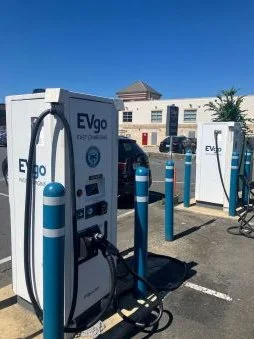
24/7 Accessible Chargers Behind Bakeshop & Aldi, ~ 50 kW each
CITY ACTIONS: In parallel, the City government should reduce obstacles to EV ownership. Most households are in multi-family buildings, so the City should work to get more publicly accessible chargers installed around town. The City imposes higher property taxes on a new EV than on a comparable internal-combustion vehicle. The City could return that windfall to buyers by funding home and/or public chargers. To pursue concepts like these, the City needs to fund enough staff to implement the EV Actions within the CEAP.
REDUCE BUILDINGS’ EMISSIONS
MWCOG estimates that in 2023 the built environment contributed 50% of the community's local emissions:
Commercial electricity use: 18.1% of all emissions
Residential gas use: 10.0% of all emissions
Residential electricity: 9.8%
Refrigerants leaking from HVAC and refrigeration appliances: 6.6%
Commercial gas use: 4.7%
Other: 0.8%
Back in 2005, electricity was a much larger contributor to our emissions. By 2023, despite population and housing units increasing by about 44%, residential electricity use had increased by only 10% as old buildings were renovated or replaced with more efficient ones and as appliances were replaced with more efficient and/or electric versions (e.g., air conditioners, Energy Star appliances, LED lights).
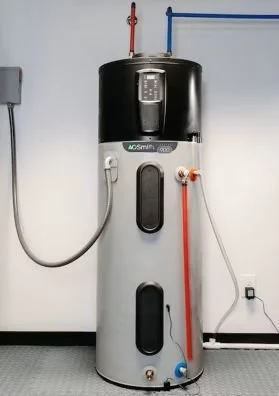
Heat Pump Water Heater (A.O. Smith model)
Meanwhile, Dominion Energy has been switching away from coal to lower-carbon fuels, primarily fossil gas, aka natural gas, and investing in renewable electricity generation. Our total 2023 net GHG emissions were down by about 29,100 metric tons (18%) vs. 2005. And 98% of that drop, over 28,400 tons/yr, was associated with our greener electricity supply. Every year, political pressure is needed to make Dominion Energy meet its renewables- and battery-capacity requirements under state law. Meanwhile, residents must make their own investments:
1. Home Energy Audits: Air leakage can be a significant source of energy loss in homes. Residents should get a home energy audit to learn how best to save on heating and cooling costs. Falls Church will be offering funding to support some home energy audits later this year.
2. Heat Pumps: When residential and commercial gas-fired space- and water-heating systems are due for replacement, they must be switched to electric heat-pump versions. This cuts GHG emissions immediately and will continue to do so as Dominion shifts to more renewables.
3. Rooftop Solar: This year especially, every homeowner should investigate rooftop solar. With the end of federal solar tax credits for individuals, installers are emphasizing solar leases. The installer claims the business tax credit and depreciation; if your home is suitable, you pay the installer a flat monthly amount that may be less than or comparable to the rate you'd be paying Dominion annually. This approach requires very little upfront investment by the homeowner. But, these systems must be installed by the end of 2027, when the business tax credit expires.
MOST IMPORTANTLY, MAKE PLANS NOW
Air-sealing, EVs, water heating, space heating, and solar…pick one, make yourself a plan, and then move on to the next one. Then you’ll be ready to make the right decision when the time comes. Individuals have the power to attack the climate crisis. Reach out to free local resources like the Falls Church Climate Action Network, GoElectricDMV, and the City’s One Stop Shop for Energy Action to help you navigate your options.